


Completely customized according to different customer needs
Contact Us
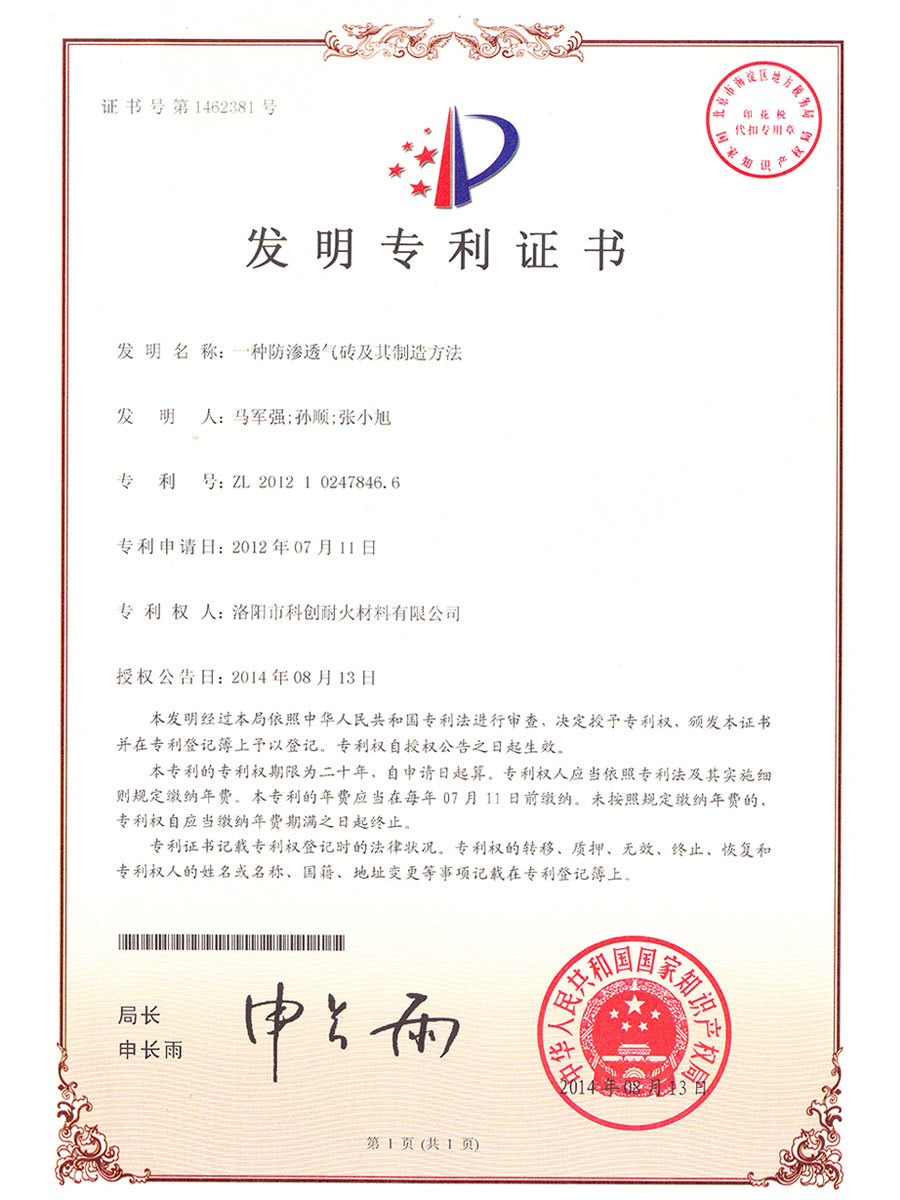
This product is manufactured using high-purity raw materials fired at high temperatures, boasting excellent performance characteristics such as thermal shock resistance, corrosion resistance, non-permeability to steel, and non-permeability to molten copper. It consists of a base brick and an anti-permeation gas core (which includes breathable components, a safety indicator, and sealing elements), with argon or inert gas supplied through the breathable components. It is suitable for ladle refining processes in steel plants, including LF, LF-VD, and CAS-OB ladles, as well as bottom-blown argon processes in continuous casting ladles. It can also be used in non-ferrous metallurgical applications such as copper smelting, aluminum smelting, and nickel smelting, and is compatible with copper refining furnaces, alloy melting furnaces, holding furnaces, and ladle bottom-blowing systems for molten metal transfer. This technology enables efficient molten-metal stirring, uniform temperature distribution, impurity removal, and prevention of slag buildup. The product requires minimal cleaning or no cleaning at all, boasts a high blow-through rate, long service life, and excellent safety performance. Compared to conventional slit-type breathable bricks, this product offers enhanced safety, energy savings, and emission reductions, helping users cut costs and improve efficiency—though specific results may vary depending on the application scenario.

The GW series slit-permeable bricks are made from high-purity raw materials through vibration molding and high-temperature firing. They supply argon gas via slits in the brick core, exhibiting high hot-state strength, excellent thermal shock resistance, corrosion resistance, and erosion resistance. Their overall performance matches or surpasses that of similar imported products from abroad. These bricks can be widely used in ladle refining processes such as LF, LF VD, and CAS OB in steelmaking, as well as in bottom-blown argon processes for continuous casting ladles. They are also suitable for stirring, homogenizing temperature, and impurity removal in non-ferrous metallurgical processes involving copper, aluminum, nickel, and other non-ferrous metals, meeting the demanding requirements of high-temperature and highly corrosive operating conditions. The products boast long service life, high blow-through rates, and outstanding safety and stability. They have been reliably deployed in major metallurgical enterprises including Shagang, Nangang, Yonglian, Tanggang, Bensteel, Huai Steel, and Longteng Special Steel.

This product is made from high-purity raw materials and produced through vibration molding followed by low-temperature heat treatment. The product supplies argon gas via narrow slots in its permeable brick core. It boasts high hot-state strength, excellent thermal shock resistance, superior corrosion resistance, and outstanding erosion resistance, with overall performance equal to or surpassing that of comparable imported products from abroad. It is suitable for bottom-blown argon processes in LF, LF-VD, and CAS-OB refining ladles in steel plants, as well as in conventional continuous casting ladles. Additionally, it can be used in the smelting of non-ferrous metals such as copper, aluminum, and nickel, and is compatible with copper refining furnaces, alloy melting furnaces, holding furnaces, and molten-metal transfer ladles for bottom-blown argon applications. This enables effective molten-metal stirring, uniform temperature distribution, impurity removal, and improved metal recovery rates. The product features a long service life, high blow-through efficiency, excellent safety, and stable operation. It has been steadily applied in enterprises including Shagang, Nangang, Yonglian, Tanggang, Bensteel, and Longteng Special Steel, earning unanimous praise from customers.

This product is made from high-purity raw materials and is formed via vibration casting followed by low-temperature baking. It boasts advantages such as high hot-state strength, excellent thermal shock resistance, corrosion resistance, erosion resistance, and the ability to undergo hot repairs. Customization is available upon customer request to meet diverse operational requirements. The product is widely applicable in metallurgical processes such as continuous casting in steelmaking and refining furnaces. It can also be used in conjunction with non-ferrous metal smelting processes for copper, aluminum, nickel, and other metals, and is suitable for scenarios including copper melting furnaces, holding furnaces, refining furnaces, and molten-metal transfer ladles. It exhibits outstanding resistance to high-temperature molten-metal erosion, stable sealing performance, and easy installation. Currently, the product has been stably deployed at units such as Shagang, Huaigang, and Henggang, and has received unanimous praise from customers.

The split-type breathable bricks can be equipped with either slotted or anti-permeation gas cores. They consist of a breathable core, a base brick, and high-quality refractory mortar—all three components can be purchased separately. The breathable core can be hot-repaired and replaced, offering flexible operation and meeting the requirements of various refining conditions. These bricks are suitable for bottom-blowing argon processes in LF, LF-VD, and CAS-OB ladle furnaces used in steelmaking, as well as in conventional continuous casting tundishes. They can also be applied to the smelting of non-ferrous metals such as copper, aluminum, and nickel, and are compatible with copper melting furnaces, refining furnaces, holding furnaces, and molten-metal transfer ladles for bottom-blowing applications. They meet the operational demands of high-temperature molten-metal stirring, temperature equalization, and impurity removal. The high-quality refractory mortar used for assembling split-type breathable bricks is primarily made from high-purity corundum and enhanced with various additives. It requires only the addition of water on-site for preparation and use. This mortar boasts advantages such as high refractoriness, easy mixing, strong bonding strength, safe handling, and easy disintegration after use.

To meet the production requirements for low‑carbon and ultra‑low‑carbon steels, this product has been developed. Compared with carbon‑free precast blocks, the newly developed product is formed by friction pressing, enabling us to readily tailor bricks to specific specifications—whether carbon‑containing or carbon‑free—to accommodate a wide range of service conditions.



Whatsapp:15197927236
Fax:+86-379-62117605
Email:yangsp8743@163.com
Add:No. 2 Sanchuan Road, Luoxin Park, Economic and Technological Development Zone, Xin'an County, Luoyang City, Henan Province
©2025 Luoyang Kechuang New Material Co., Ltd This website supports IPv6 Privacy Policy www.300.cn SEO